
Online language certifications, academic admissions, and corporate language screenings are at a critical juncture. Test-takers are no longer relying on crib notes or proxy test-takers. Instead, they're exploiting real-time AI running on their OS.
Solutions that only trigger an alert when a test-taker switches tabs or uses an external mobile phone are insufficient for the threat
Restoring integrity to computer-based language assessments requires an understanding of how test-takers are circumventing basic security measures and the implementation of layered security controls.
The New Threat Vectors in Remote Language Exams
Modern AI tools bypass conventional web-based proctoring applications entirely by acting at the OS kernel level or hardware layer.
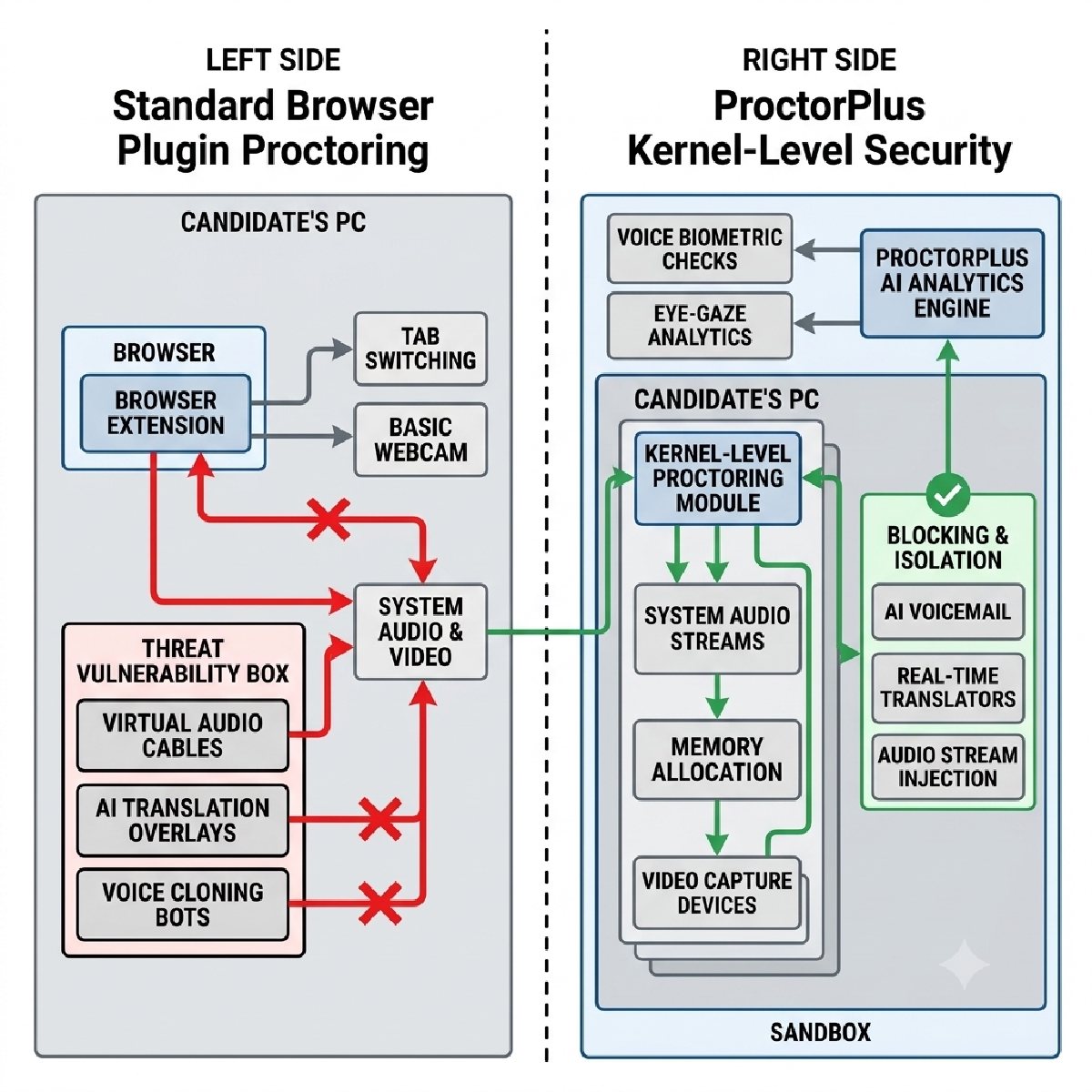
Real-Time AI Speech Translation Overlays: Desktop applications (such as Transync AI) capture live audio output from an interviewer or prompt, transcribe it instantaneously, run it through an LLM, and display translated responses on a bilingual floating overlay. These overlays remain invisible to standard browser event listeners and traditional screen-sharing protocols.
AI Voice Cloning & Audio Stream Hijacking: Fraudulent test-takers use virtual audio cables (e.g., VB-Audio, Loopback) to route incoming speech into an AI translation engine. The system then outputs synthesized speech back into the test environment using cloned voice models, allowing non-fluent candidates to sound natural in real time.
Smart Eye-Tracker Evasion: Candidates place transparent teleprompter windows beside their webcam or the main exam portal. Since they are looking at or close to the line of sight of the camera, single camera monitoring does not raise alerts about unnatural eye movements.
Off-Camera Proxy Communication: Secondary hidden displays, external HDMI pass-through devices, and Bluetooth earpieces allow off-site assistants to stream answers directly to the test-taker.
Why Legacy Proctoring Fails to Stop AI Fraud
Standard proctoring solutions were built for an earlier era of online testing. They rely primarily on web-browser plugins and basic JavaScript scripts to monitor behavior.
Browser-Level Restrictions Are Easily Bypassed: Basic extension-based proctoring only tracks actions taking place within the active browser tab. They cannot detect native desktop applications, background processes, or virtual audio routing software running outside the browser context.
Single-Camera Blind Spots: Front-facing webcams capture a narrow field of view. They cannot monitor physical desk space, hidden secondary monitors, or hardware pass-through setups.
Manual Human Review Bottlenecks: Expecting remote human proctors to manually spot subtle latency delays or micro-gaze deviations across dozens of simultaneous streams is unscalable and introduces human error.
A Multi-Layered Defense Model for Language Assessments
Protecting high-stakes language certifications such as IELTS Online or PTE Academic demands a comprehensive, multi-layered security architecture.
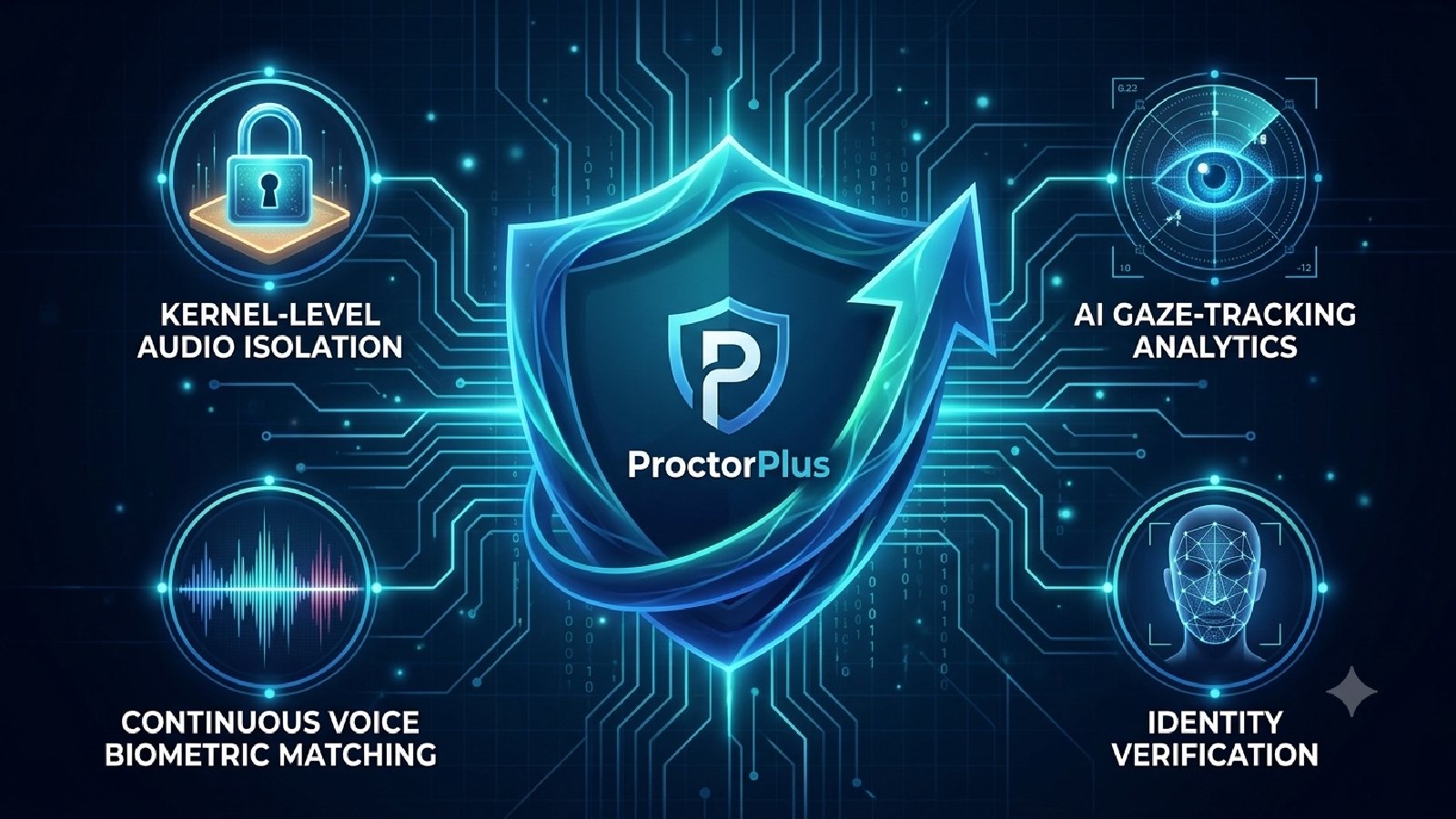
Kernel-Level Sandboxing & Application Isolation: Restrict the testing environment to prevent background applications, virtual audio drivers, and floating overlays from launching during the exam session.
System Audio Stream Verification: Monitor and analyze active system audio devices to detect virtual audio cables, unauthorized loopback interfaces, or real-time speech synthesis software.
Voice Biometric Verification: Implement continuous voice matching to compare the candidate's live speaking voice against a baseline biometric voiceprint established during identity check-in.
Dual-Camera & Environmental Scanning: Require a mandatory secondary camera angle (via mobile device or external webcam) to monitor the candidate's hands, desk environment, and physical display hardware. Organizations like ETS for TOEFL iBT Home Edition utilize dual-camera setups and voice biometrics to maintain test security.
Automated AI Behavioral Analytics: Utilize gaze tracking and micro-expression analytics to flag non-standard reading patterns, unnatural audio delays, and off-screen focus shifts automatically.
Securing Language Exams at Enterprise Scale
Maintaining the international credibility of language proficiency scores requires proactive security measures. Organizations must audit their current proctoring infrastructure to identify vulnerabilities exposed by modern AI translation tools.
Ready to protect your language testing pipeline from real-time AI translation and voice cloning fraud? Book a Demo with ProctorPlus to explore our automated, enterprise-grade assessment security platform.